 Ukraine Military History Institute
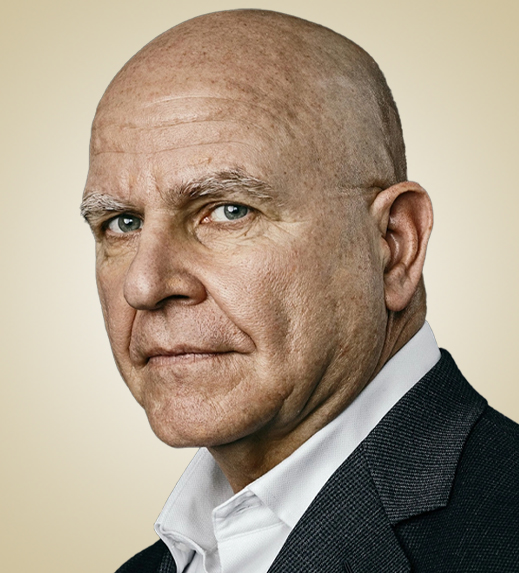 H.R. McMaster
 Samuel P.N. Cook host
Putin works on Western leaders with "kind of a four-step process," says H.R. McMaster, former US National Security Advisor: flatter the leader, claim a shared grievance, hold out a big deal, and portray any alternative as weak. Countering that playbook is the first step, he thinks, to getting America and Europe on the same page over Ukraine.
The question came from Tobias Ellwood, a former UK defence minister, at the Ukraine Freedom Summit in London. "The elephant in the room seems to be that America and Europe are not on the same page," Ellwood said, and asked how McMaster would persuade his former boss "to come to the table on the European side and not court Putin." McMaster's answer began with Putin, not with Washington. "First of all, I think you have to be able to counter Vladimir Putin's deception and influence campaigns."
The four steps
Putin tailors the approach to each leader, McMaster says, because the SVR and GRU "study these leaders and try to understand really how they can manipulate them as best they can." He credits Putin with a great track record, from Chancellor Merkel to "really all U.S. presidents, I would say."
Flattery. First, Putin flatters the leader and tries to ingratiate himself. "You've seen this with President Trump, but many others as well." McMaster's examples are the portrait Putin had done for Trump, and Putin telling Trump he went to pray for him after the assassination attempt. Beyond those, Putin "makes many public statements that are meant to flatter that leader."
A shared grievance. Second, Putin tries "to create a sense that he is aggrieved," and that there is "some kind of mutual aggrievement there." The grievances on offer are NATO enlargement, "so many offenses against him," and the claim that he is fighting Nazis in Ukraine.
The big deal. Third, he "will hold out the prospect for some really big deal or something great that could be done together." In this case, McMaster says, that means "all these efforts to try to talk about issues other than Ukraine." His example of the pitch: "Wouldn't it be great if we could reduce nuclear weapons?"
Everyone else is weak. Fourth, Putin portrays any other alternative, or his competitors, as weak, "like he's trying to do with President Zelensky," while presenting himself as strong. "So you have to counter that."
Hear McMaster lay out Putin's four steps at 28:40
Hear H.R. McMaster on this, at 27:16From “Putin Will Not Stop Until He Is Stopped”The two arguments that work with Americans
Countering Putin is half of McMaster's answer. The other half is what to say to the American public. "I think the two main arguments for Americans that are really important at this stage," he says, are these.
The first is "that the war in Ukraine is connected to this axis of aggressors," to the broader competition with China, Russia, North Korea and Iran. The second is "that unless the Russian threat can be dealt with abroad, it can only be dealt with at an exorbitant cost once it's going to reach our shores."
He does not pretend the audience for those arguments is easy. "I think that a lot of Americans and this is what President Trump channels sometimes. They feel like they have a lot of work to do at home." Their instinct, as he puts it, is "why don't we just focus on ourselves?" What they miss, in his view, is "the degree to which Ukraine has been fighting a war for all of us on this frontier." He calls this "the argument I've been trying to make in The Economist and other places," and he thinks all of us need to keep helping citizens understand that the war matters to Ukrainians, to humanity, and "directly to the interests of those citizens as well."
Why the axis argument comes first
The axis argument is the spine of McMaster's whole talk. At the strategic level, he thinks we have to acknowledge that what Ukraine is coping with "is not just the aggression of Russia. It's the aggression of an axis of aggressors": Russia and China, as well as North Korea and Iran. China feeds "Putin's ATM" and supplies electronics and hardware. North Korean troops are fighting on European soil, "maybe at least 6,000, maybe up to 30,000 more coming," and North Korea has provided "about 10 million, I think the number is, rounds of artillery." Iran supplies Shahed drones.
The four have different objectives "maybe," he says, but share one: tearing down the existing rules and replacing them with rules "sympathetic to their authoritarian forms of government." And he thinks the axis is "provoked by weakness." He traces the perception of Western weakness to the unenforced red line in Syria in 2013 and the withdrawal from Afghanistan, and thinks "you can draw a direct line" from that to the February 2022 reinvasion. The answer, he says, is to "portray strength against that entire axis."
The same logic, that Russia moves where it senses weakness, runs through Francis Farrell and Rob Lee on what stops Russia testing NATO in the Baltics.
What Anchorage showed
A later question from the floor asked what role diplomacy should play. McMaster's reading of Anchorage is that "Putin didn't get what he wanted." What Putin wanted, he says, was for the United States "to approve for conditions for a ceasefire that were unacceptable to Ukraine," and then to use that gap "to drive a wedge between the United States and Ukraine and the United States and Europe."
The wedge did not hold, in his account. Trump, he thinks, did not buy Putin's efforts there, and "I think European leaders had a very major role in that." If diplomacy includes heads of state as well as diplomats, he thinks the diplomatic effort by European leaders "was very effective before Anchorage and after Anchorage."
No diplomacy without the shadow of power
McMaster's condition for any diplomatic progress is that it is backed by force. He quotes George Shultz, a former Secretary of State at the Hoover Institution where McMaster now works: "negotiation is a euphemism for capitulation unless the shadow of power is cast across the bargaining table." Divorcing diplomacy from what is done militarily and economically, he says, is "a recipe for disaster." His example of the habit is America announcing its Afghanistan withdrawal timeline while talking to the Taliban in Doha.
He names two things that are necessary. The first is sustained support for Ukraine, with Europeans paying for weapons, including US weapons. He would add a long-term, low-interest loan to Ukraine, like the loan to Finland in 1919, which he notes was paid back in full. The second is "maximum pressure, not only on Russia, but on the axis of aggressors who are aiding and abetting them."
Asked by a Ukrainian in the audience what leverage the free world really has, he listed seized Russian assets, European and American, as "step A," then secondary sanctions on banks facilitating illicit transactions, Chinese banks for example, and pressure on the shadow fleet and on buyers of Russian oil. He points to an essay by Marshall Billingslea setting out "like 10 sanctions," and he is clear about his limits: "I'm not an expert in this area." His view is that all of those measures should be taken immediately, because "I don't think this incremental approach is working."
Put together, McMaster's answer to Ellwood is a sequence. Expose the four steps Putin uses on each leader. Tell Americans the war is part of a contest with an axis, and cheaper to fight abroad than at home. And give diplomacy something to stand on, because in his view Putin "won't be stopped until he concludes that he's losing the war or that he can't continue the war, at least, at an acceptable cost."