 Ukraine Military History Institute
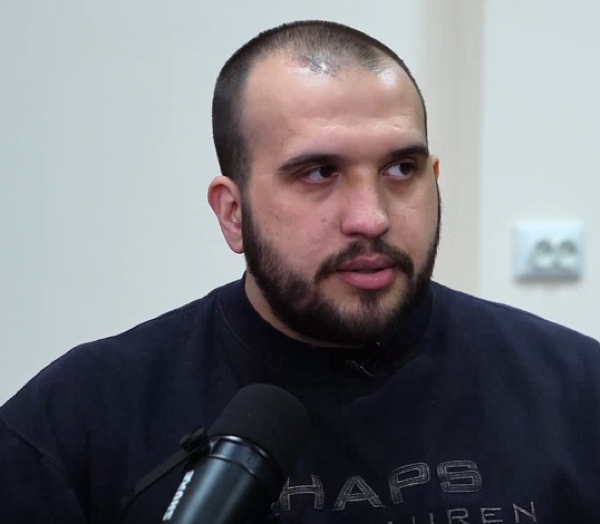
 Vladyslav “Shram” Tovstyi
 Rob Lee
 Samuel P.N. Cook host
Myrnohrad's 9-storey buildings gave Ukrainian drone pilots extra armour until Russia turned its KABs and FABs on them, says Vladyslav Tovstyi, commander of the UAV Battalion Corsair in the 38th Marine Brigade. "When 50 KABs and FABs arrive in a day," he told Rob Lee, "it becomes very difficult to keep the defense."
Tovstyi began on drones like the Mavic 2 and Mavic 3. His battalion started small, "working with just a couple of guys," and grew into a unit with five directions: wing, bombers, FPV, reconnaissance and ground robots. When the brigade entered the Myrnohrad direction in 2024, he says, enemy losses in two months "were up to 2,000 personnel." The Russians then tried to push, "roughly speaking, for a year and a half." The infantry held the concrete fortifications. "But the concrete did not hold."
Why the high-rises mattered to drone pilots
Rob Lee asked how drone work differs between a town and the tree lines. Tovstyi answered from Myrnohrad, where his battalion had positions in both. "The only advantage was that we had 9-storey buildings, which gave us additional armor."
That armour went to the pilots. "Our pilots had hubs that were better protected, under better cover," he says. Better protected positions let the battalion hold its positions in the tree lines in front of Myrnohrad longer and help the infantry, "until the enemy finally decided on the main direction and began to use all the KABs on these multi-storey buildings." Earlier in the conversation he described FABs "that collapsed 9-storey buildings with one flight."
In his account, the buildings protected the drone crews only until Russia chose its main direction and turned its glide bombs on them.
Hear Tovstyi make this case at 13:51.
Rob Lee's wider argument about what glide bombs have and have not achieved on the front is in glide bombs never broke the line.
Hear Colonel “Shram” Tovstyi on this, at 13:51From “Inside the Battalion That Killed Over 2,000 Russians in 2 Months”Town or tree line: which is better?
For infantry, Tovstyi is clear. "If in the urban area there are more shelters, more places to hide, it will be more difficult for the enemy to detect us. And in the field, in a tree line, you can't hide well and the enemy finds your positions very quickly. Therefore, for the infantry, the urban area is much better."
In the fields, the weather sets the terms. In autumn or winter, he says, "it's equally hard to covertly bring personnel to positions, rotate them, bring in supplies, ensure enough FPV drones." The same applies to the other side: "the enemy also has to move towards us using the same routes." Russian groups are detected early and face the same difficulties.
What decides the field fight, in his view, is endurance and reach: whoever can supply positions longer with ammunition and provisions, and keep hitting the enemy. "If we have a normal line of defense behind us, where we can reach the enemy, their crews, their infantry, and the enemy will not reach our equipment and will not be able to hit, then we will have a priority." It all depends, he adds, "on who has the best distribution."
The three layers of strike
Tovstyi explains the defence of positions like Myrnohrad's as three layers working together. "The point of a deep strike, a middle strike and a close strike is to get as few enemies as possible to our positions."
The deeper layers hit Russian control points and the places where personnel are gathered, and the transport moving fuel, ammunition and personnel to the front. The infantry heading for a position "is already being destroyed by the nearby attacks." That close layer, he says, "worked constantly and effectively." Its limit was arithmetic: "simply because of the number of the enemy, which arrived on our positions," the battalion "didn't always manage to destroy everyone."
The numbers come from Russia's infiltration method. Small infantry groups try to get through; when one fails, the next goes, until they reach the area. Russia has more manpower, "cannon fodder, as I call it," than Ukraine has people it values and tries to keep alive. "That's why they manage to move a little."
Has the middle strike changed the front yet?
Not yet, on his sector. Asked whether Ukraine's middle strike campaign was making it harder for Russia to fight at the front, Tovstyi said: "So far, we do not see any significant changes." He calls it "a long-term perspective": Ukraine has "just started cutting their logistics," and Russia "still have reserves." When those run out and cannot be replaced, "then there may already be improvements."
His expectation, hedged as his own view, is that the combination will tell. "I think that the enemy will have to go to negotiations, to a defense fight, to a stop on the line of contact, because he simply will not be able to bring the personnel to our positions." Rob Lee's own verdict on the campaign is in Ukraine's middle strike campaign.
Some pressure is already visible to him. The enemy, after a very long period of offensive operations, "is now running out of steam." In his area, he says, the enemy activity "decreased by 60%, as for me."
After Russia took the buildings
Rob Lee asked whether Russian control of much of Myrnohrad, including some tall buildings where antennas can be mounted, made the fight harder. Tovstyi described the reverse of his own experience. When the Russians took over these buildings, "they used all their KABs and FABs to collapse them while we were inside."
Ukraine cannot answer in kind. "Unfortunately, we don't have the same number of FABs," he says. Instead his pilots prepare FPVs, "set up an ambush, wait for the pilot until he comes out," fly into the windows and work on enemy antennas, pressing the enemy so he cannot use all his resources. It takes all the units in the zone together, because "if we let the enemy work calmly from these high-rises, we won't have a life."
Logistics stays difficult, he says, because the enemy has FPVs too. "But for now we control the enemy."
Tovstyi's account of Myrnohrad turns on one trade. Concrete and height protected his pilots and let the close-strike layer keep working, until 50 KABs and FABs a day made the buildings untenable. What he thinks will change the outcome is the deeper layers: cutting what reaches the front before it gets there.